Research
As part of the CRISTAL collaboration, I use multiwavelength observations from ALMA and JWST to study galaxies at z ∼ 5 on kiloparsec scales. At UCSB, I used HST photometry to study how the star formation history varies across the dwarf galaxy J1044+0353.
CRISTAL · Current work
I’m studying how the –SFR relation varies with the physical conditions of ionized gas. I use nebular emission lines in JWST/NIRSpec IFU spectra to estimate the gas-phase oxygen abundance, , and the ionization parameter, . I combine those estimates with high-resolution ALMA maps to make the comparison on kiloparsec scales.
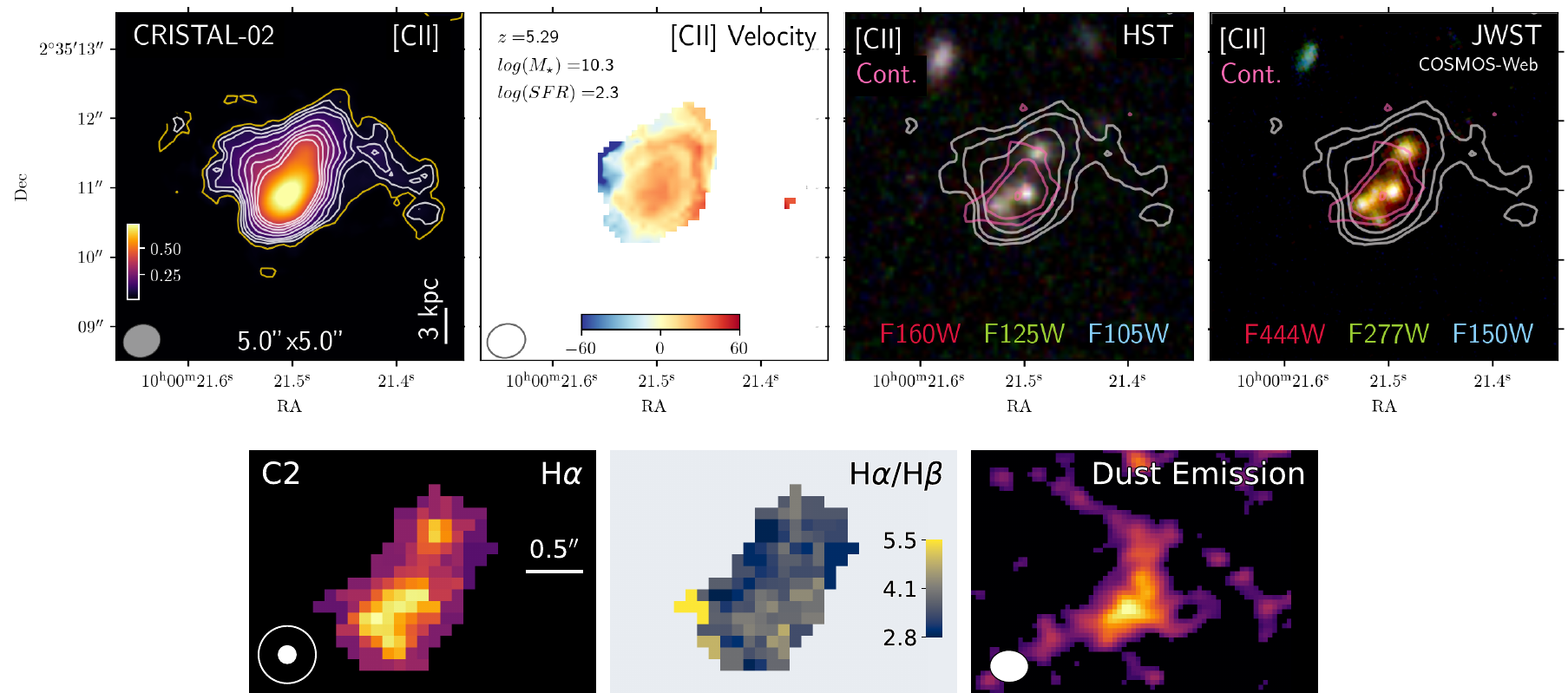
Herrera-Camus et al. 2025 · Fig. 11; lower panels: Yuan Li.
Star Formation History, region by region.
UCSB · 2022–2023 · J1044+0353
J1044+0353 is a nearby, metal-poor dwarf with a compact starburst and unusually strong emission lines, making it a local analog of young galaxies from the reionization era.
I used Photutils to separate the starburst into four regions in the HST F336W image, then measured their fluxes in eight filters. I fitted the photometry with BEAGLE, comparing a single burst with constant star formation under two dust laws.
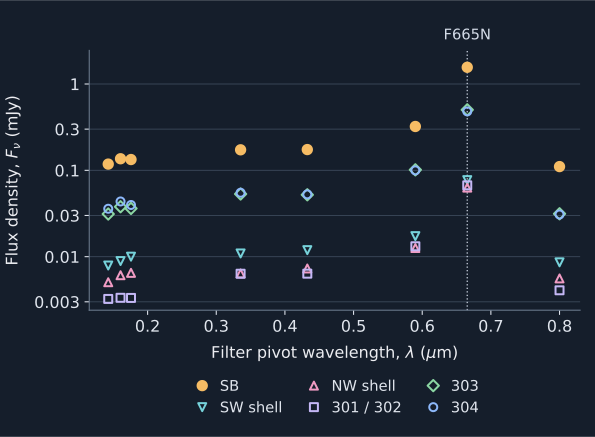
In the single-burst fits, the regions are about 3 Myr old, except the southwest shell at about 5 Myr. With constant star formation, the maximum stellar age is 17–22 Myr in the southwest shell and 9–10 Myr in the northwest shell, depending on the dust law.